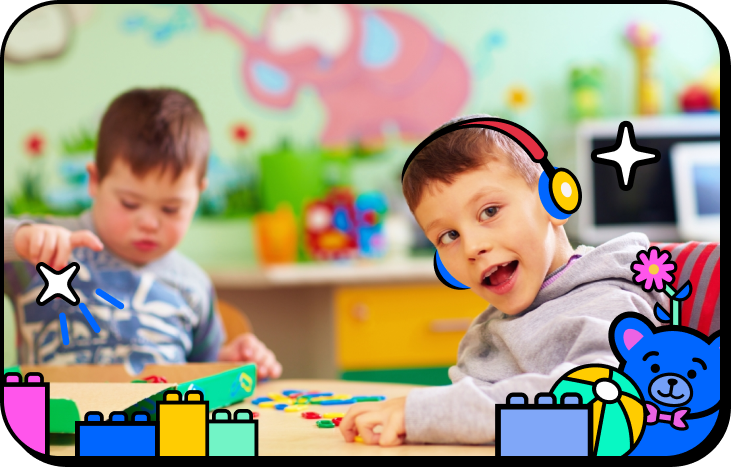
WonderTree offers free online sensory games for autistic children that support purposeful interaction, skill development, and meaningful participation. Our motion-based games help improve action-reaction, hand-eye coordination, spatial awareness, and body awareness — all through play that feels natural and rewarding.
What is Autism Spectrum Disorder (ASD)?
Autism Spectrum Disorder (ASD) is a neurodevelopmental condition that affects how a child communicates, interacts with others, and processes sensory information. The term spectrum reflects the wide range of strengths and challenges each autistic child may experience. Some children may have difficulty with verbal communication, while others may struggle with social cues, sensory sensitivities, or repetitive behaviors. According to the CDC, approximately 1 in 36 children in the United States is identified with ASD.
Free Autism Games by WonderTree
Each WonderGame is designed to support specific developmental goals while keeping children motivated through fun, interactive gameplay. All games are free to play and require no downloads.



- 1 Sign up free — no download
- 2 Allow your webcam
- 3 Play & watch progress
How Online Games Help Children with Autism
Research consistently shows that interactive, play-based activities can support developmental progress in autistic children. Online games offer a structured yet flexible environment where children can practice skills at their own pace, with immediate visual and auditory feedback that reinforces learning.
Key ways games support autistic children:
- Predictable routines — Games follow consistent rules and patterns, which can feel comforting and manageable for children who thrive on structure
- Sensory integration — Visual and auditory game elements provide controlled sensory input that helps children practice processing and responding to stimuli
- Motivation through play — When an activity is enjoyable, children are more likely to stay engaged and repeat it, leading to more consistent skill practice
- Safe social practice — Virtual environments let children practice turn-taking, joint attention, and following rules without the pressure of face-to-face interaction
- Independence — Children can play and progress without constant adult direction, building confidence and self-regulation
Benefits of WonderGames for Children with ASD
WonderTree's online autism games are designed to complement traditional therapies and classroom learning. Each game targets specific developmental areas while keeping the experience playful and accessible for children of varying abilities.
- Social skills activities that foster communication, help recognize social cues, and encourage confident interaction with others
- Therapeutic activities for autistic teenagers that support motor development, sensory regulation, and communication in an engaging format
- Autism-friendly activities for adults that enhance cognitive and motor abilities in a safe, confidence-building environment
- Free online games accessible to all families, designed for every age on the spectrum — from preschoolers to adults
Skills Children with ASD Develop Through WonderGames
Regular play with WonderTree's games helps children with Autism Spectrum Disorder build real, measurable skills:
- Engage with their surroundings more purposefully and consistently
- Enhance visual perception and pattern recognition
- Refine and synchronize gross and fine motor skills
- Improve communication through joint attention exercises
- Respond more effectively to sensory input (proprioceptive, tactile, visual, auditory)
- Boost cognitive functions including classification, memory retention, and sequencing
Tips for Parents: Getting the Most Out of Autism Games
- Start with short sessions — Begin with 5–10 minutes and gradually increase as your child becomes more comfortable with the game format
- Follow your child's lead — Let them choose which game to play and how long to play it. Autonomy increases engagement and reduces resistance
- Celebrate small wins — Acknowledge effort, not just results. Progress in focus, coordination, or communication can happen gradually
- Pair with therapy goals — Share your child's game progress with their therapist or teacher to align play with developmental objectives
- Create a calm environment — Reduce background noise and distractions to help your child focus on the game and sensory input
Frequently Asked Questions
The best online games for autistic children are those that offer clear visual feedback, predictable patterns, and adjustable difficulty levels. WonderTree's motion-based games like SCOOP'D and BUBBLE POP are specifically designed to support sensory processing, motor coordination, and cognitive development in children with ASD. They are free, require no downloads, and can be played at the child's own pace.
Yes, all of WonderTree's autism games are free to play during a 14-day free trial. There are no downloads or installations required — children can start playing immediately in any web browser with a webcam.
Interactive online games can support sensory integration by providing controlled visual and auditory stimulation in a predictable, structured environment. Games like WonderTree's help children practice responding to sensory input — such as tracking moving objects, reacting to sounds, and coordinating hand-eye movements — at a pace that feels manageable.
Through regular play, autistic children can develop attention and focus, hand-eye coordination, visual perception, motor planning, communication through joint attention, sensory processing, and cognitive skills like pattern recognition and memory. The key is consistent, engaging practice in a low-pressure environment.
Yes. WonderTree offers games designed for all ages on the autism spectrum, including teenagers and adults. These games focus on sustained attention, motor coordination, cognitive flexibility, and daily living skills — all through engaging, age-appropriate gameplay that respects the player's independence.
WonderTree's games use webcam-based motion tracking, which means children can play using upper body movements, head movements, or hand gestures. The games are designed to accommodate children with varying levels of mobility, including those who use wheelchairs. Difficulty levels can be adjusted to match each child's range of motion.